 nk
nkBreeze Airways Embraer 190 Seat Map
Last verified August 4, 2026E190 / E90Official Breeze Airways fleet page ↗
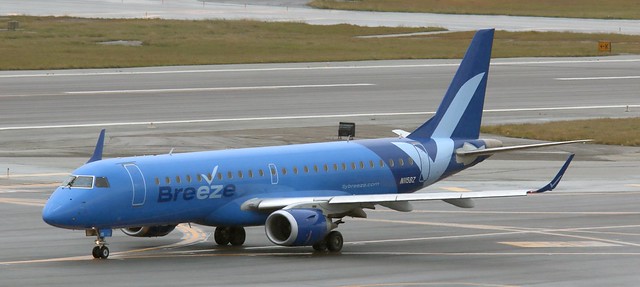
See the best seats for you
Set your seat preferences — legroom, quiet, window views — and this map recolors to match what you care about.
Cabin details
- IFE
XL
- Seatstandard
- Pitch33"
- Width17.6"
- Recline3"
- Materialleather
- IFEstreaming
- Air ventssingle
- Tray tableseatback
Economy
- Seatstandard
- Pitch29-30
- Width17.6"
- Recline3"
- Materialleather
- IFEstreaming
- Air ventssingle
- Tray tableseatback
Picking Your Row on Breeze's E190
Most of the cabin on this jet is straight economy — rows 13 through 27, two-and-two, 29–30 inches of pitch, 17.6-inch seats. It's a small aircraft with a single aisle and one lavatory/galley zone at each end, so the entire game here is staying away from those two ends and understanding what Breeze's XL rows up front actually buy you. Entertainment streams to your own device throughout, so window alignment matters more than usual — there's no seatback screen to stare at instead.
Row 1: legroom, with strings attached
1A, 1B, 1C and 1D are bulkhead seats with genuine extra stretch-out room, and they'll be the first four people off the plane. The trade: a bulkhead wall means nothing goes under your feet for takeoff and landing, the armrests are fixed so the seat feels slightly narrower than the 17.6 inches suggests, and you're right on top of the forward lavatory and galley. 1A and 1B catch the lav traffic; 1C and 1D get the galley clatter and the crew working through it. If you're tall and it's a short hop, take them anyway. If you want to sleep, don't.
Rows 2–10: the quiet part of XL
Rows 2 through 10 are the unglamorous winners of the XL block — 33 inches of pitch, normal underseat storage, moveable armrests, no lav or galley next door, no exit-row restrictions. Rows 10 onward sit over the wing, where the view out is mostly aluminum, so if the window is the point, aim for rows 2–9 on the A or F side. Worth knowing about the E190 generally: the large eye-level windows don't line up perfectly with every row, so a "window" seat can end up with a pillar or an offset frame. Pick from the front half of XL and you're playing better odds.
Row 11: the one XL row to skip
11A, 11B, 11C and 11D are the weak link in the premium block — recline is limited because row 12 is the exit row behind them, and 11A/11D are over the wing on top of that. You pay the XL fare and get a seat that barely moves. Slide one row forward or one row back instead.
Row 12: the best seats on the aircraft
12A, 12B, 12C and 12D sit at the exit with a door immediately ahead, which means extra legroom on top of the 33-inch XL pitch. These are the standout picks in the forward cabin. 12A and 12D are over the wing, so treat them as legroom seats rather than view seats, and expect the usual exit-row conditions — bag in the bin during taxi, and you need to be willing and able to help.
Rows 13–25: standard economy, front is better
Pitch drops to 29–30 inches here. Nothing in rows 13 through 25 is flagged as problematic, so choose on position: rows 13–15 for a faster exit and distance from the rear galley, though 13 through 16 are still over the wing with a restricted view. Once you're past row 17, the windows open up again and you're still comfortably clear of the back of the plane.
Rows 26–27: the seats to give away
The rear is where this cabin falls apart. 26C and 26D are squeezed between the aft lavatory and galley — constant standing traffic in the aisle beside you and noise from both. 27A and 27C back onto the lavatory, and 27D and 27F sit against the galley; recline is limited in the last row, and you'll be among the last off. If the map only leaves you rows 26–27, take 26A or 26F over anything in the middle of that block.
Video reviews
What travel bloggers say
- Calls the 2-2 layout the best thing about the Embraers — nobody gets stuck in a middle seat, and the 17.6-inch-wide leather seats are well padded and a clear step up from slimline ultra-low-cost seats, aside from the lack of a winged headrest.
- Found the standard "Nice" section on the E190 tight at 29 inches of pitch, while the light-gray extra-legroom "Nicer" rows run 34–37 inches and can be added to a Nice fare for roughly $20–$50.
- Recommends row 2 at 37 inches even over the 39-inch exit row 14 because you deplane faster, and says skip row 1, where the bulkhead eats legroom, the armrests don't move and everything must go overhead.
- Warns off row 13, which sits ahead of the exit row and doesn't recline, and the last row 30 for limited recline and galley noise.
- Reports no Wi-Fi and no inflight entertainment at all onboard, but praises the enormous roughly 14 x 13-inch windows and a 17.5 x 11-inch tray table that fits a 13-inch MacBook Pro; the aft lav gets cramped when a line forms.
- Frames Breeze as an ultra-low-cost carrier with no frequent flyer program, flying a 35-plus aircraft fleet of A220-300s, E190s and E195s.
- Explains that Nice fares are essentially basic economy and Nicer is the mid-tier bundle, while the top Nicest product is A220-only — so Embraer flights top out at Nicer.
- Draws on two Breeze flights, Raleigh–Los Angeles and Raleigh–Providence, for the fare-class and onboard comparisons.
- Breaks down "BreezeThru" one-stop routings where you stay onboard through the intermediate city, including a Los Angeles–Raleigh flight that continued to Hartford.
- Booked a $39 Nice fare on San Francisco–San Bernardino and paid just $5 to move into an extra-legroom seat, for a $59 total he rates as excellent value against the cheapest comparable Southwest fare.
- Argues you can skip the $64 Nicer bundle entirely — a cheap Nice fare plus a paid extra-legroom seat saved him about $20, and the crew handed him the free Kind bar and bottled water anyway.
- Legroom in the extra-legroom row was "quite nice" and the roughly 60% full cabin left the seat beside him empty, but the padding grew very uncomfortable over time and he wouldn't want more than two hours in it.
- No seatback screens anywhere; the streamed entertainment offered only 24 movies and 30 TV shows, so he watched the window instead — the approach serves up Lake Arrowhead and the San Bernardino Mountains on the left side.
- Service was rudimentary but friendly, with the crew dressed so casually he couldn't tell whether they were in Breeze uniform; his real gripe is frequency, with the route running six times a week at a fixed 10:10 a.m. departure.
 Will Allen on Travel· Breeze Airways worked for me, but…
- Paid $30 per person to upgrade to Nicer on Raleigh–New Orleans, which bundled carry-on and checked bag privileges with the extra legroom and "worked for us just fine."
- The front row with two windows and nobody reclining ahead was a pleasant place to sit, and he was surprised by how capacious the overhead bins were for such a small jet — his wife's oversized backpack fit easily.
- The cabin looked clean at first glance but showed its age on closer inspection: dog-eared safety cards, a peeling bulkhead sign, a ripped seat pocket and a forward lav with a tap that wouldn't stop running and an empty paper towel dispenser.
- Three flight attendants ran one quick beverage service with only water free and then largely disappeared, yet he found them so genuinely cheerful he hadn't enjoyed a cabin crew that much in a long time; gate agents at Raleigh fixed his PreCheck and reprinted passes in two to three minutes.
- On the return, the flight was loaded in Breeze's system as a larger E195 than the aircraft actually at the gate, so ten already-boarded passengers had to deplane — the captain owned up to it candidly in front of passengers, but the episode makes him think twice about rebooking, as do the twice-weekl
Forum discussions
Credit cards that earn Breeze Airways miles
Cards that earn points on this airline’s loyalty program directly, or points that transfer to it.
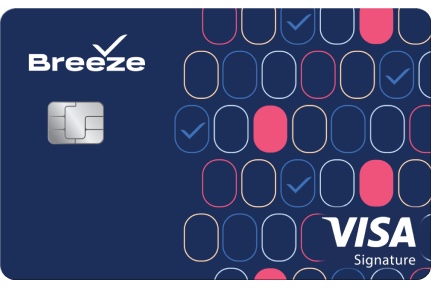 Breeze Easy Visa Credit CardEarns directly